
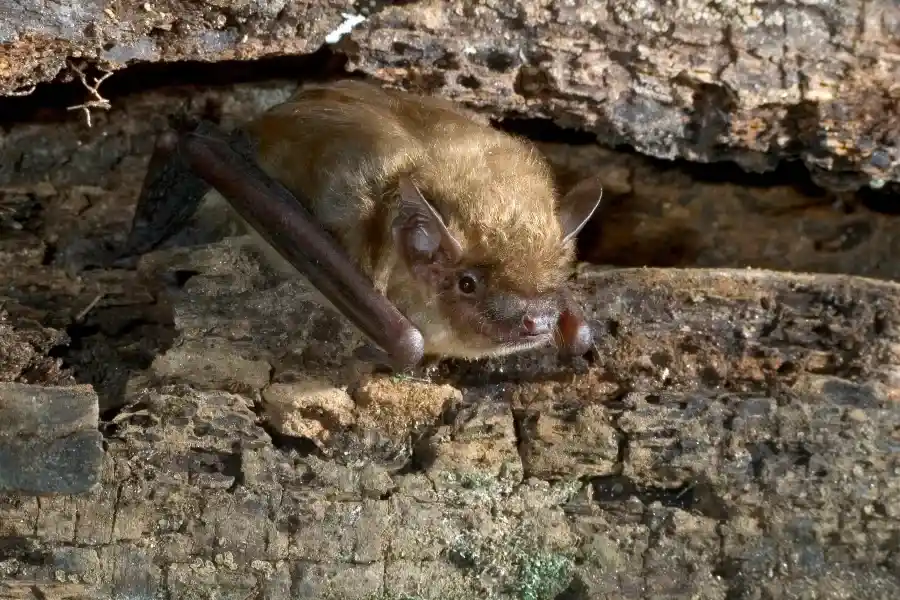
Bats are protected species – it’s always illegal to kill them, and most interactions are heavily regulated.
Resolving a bat problem legally and permanently requires professional, humanely timed exclusion—installing one-way valves over entry points so bats can leave to feed but cannot reenter—followed by complete structural sealing, guano cleanup, and biohazardous remediation.
Exclusion must be performed outside the summer maternity season to avoid trapping flightless young inside your structure.
Key Takeaways:
- Because bats are vital contributors to local ecosystems, they are protected by federal and state regulations. Resolving a bat infestation requires specialized timing and nonlethal exclusion methods.
- Handling bats directly or disturbing dry guano without specialized protective equipment poses immediate risks of rabies exposure and histoplasmosis.
- Effective bat control relies on installing one-way valves that allow bats to exit to feed while permanently preventing their return. However, be careful when you install these doors. Performing exclusion during the summer maternity season traps flightless young inside, causing extensive property damage, health hazards, and regulatory fines.
- Proper remediation extends beyond removal to include industrial HEPA vacuuming, thermal insulation replacement, and enzymatic sanitization to neutralize lingering biohazards and pheromones.
Bats play a vital role in local ecosystems by controlling insect populations, but when they roost in residential structures, they present serious health risks, structural damage, and legal complications. Property owners dealing with bat infestations face significant challenges: nocturnal noise, lingering odors, hazardous biohazards like guano, and strict federal and state wildlife protections that prohibit harming them.
Jump to a Section:
- Immediate Bat Safety Protocols and Containment
- The Step by Step Exclusion Process
- Guano Cleanup, Biohazard Remediation and Insulation Repair
- DIY vs. Professional Bat Control Solutions
- Bat Control FAQs
Immediate Bat Safety Protocols and Containment
If a bat enters your living area or you suspect roosting in your attic, immediate safety precautions are critical. Bats are primary vectors for rabies, and their droppings pose respiratory hazards.
What to Do If a Bat Is in Your Living Space
- Isolate the Room: Close all interior doors leading to other parts of the house. Seal the gap under the door with a towel.
- Open Exterior Windows: If the bat is active, open windows or exterior doors leading outside, turn off interior lights, and leave the room. The bat will often use echolocation to find the exit.
- Avoid Direct Contact: Never handle a bat with bare hands. Use heavy leather gloves, a plastic container, and a piece of cardboard only if containment is required for rabies testing.
- Do Not Release a Bat That May Have Exposed Someone: If a bat was found in a room with a sleeping person, a child, an impaired individual, or a pet, do not release it. Contact local public health or animal control immediately to arrange for rabies testing.
Health Risks: Rabies and Histoplasmosis
- Rabies Risk: Bat bites can be microscopic and virtually painless. Any direct contact or unaccounted exposure requires immediate medical consultation regarding Post-Exposure Prophylaxis (PEP).
- Histoplasmosis Risk: Fungal spores (Histoplasma capsulatum) thrive in accumulated bat guano. Inhaling these airborne spores when guano is disturbed causes histoplasmosis, a serious respiratory infection. Never sweep or vacuum dry guano without specialized personal protective equipment (PPE).
Legal Protections and The Exclusion Timing Window
Bats are protected under federal and state wildlife regulations across the United States. Killing bats, using chemical pesticides, or trapping them in cages is illegal in most jurisdictions and ineffective long-term.
The Maternity Season Restriction
During the spring and summer, female bats form maternity colonies to give birth and raise their pups. Installing exclusion devices during this period traps flightless young inside the structure. This leads to juvenile bats dying in walls or entering living spaces looking for food, causing severe odor, parasite infestations, and regulatory fines.
Because service coverage includes states across the Southeast, Mid-Atlantic, and Midwest, local wildlife regulations establish strict seasonal blackout dates:
| State | State Wildlife Regulatory Body | Regulated Maternity Season (Exclusion Blackout Window) | State Legal & Exclusion Considerations |
|---|---|---|---|
| Florida | Florida Fish and Wildlife Conservation Commission (FWC) | April 16 – August 14 | Strictly enforced under F.A.C. 68A-24.006. It is illegal to exclude or block roost entry points during this period without a special permit. |
| Georgia | Georgia Department of Natural Resources (GA DNR) | April 15 – August 15 | Protected under GA Wildlife Code. Exclusions must be completed prior to April 15 or delayed until after August 15. |
| Louisiana | Louisiana Dept. of Wildlife and Fisheries (LDWF) | April 15 – August 15 | Non-lethal exclusion required outside the maternity roosting window. |
| Virginia | Virginia Dept. of Wildlife Resources (DWR) | May 1 – August 31 | Protected under VA Code § 29.1-511. State guidelines strongly restrict exclusions when flightless young are present. |
| Maryland | Maryland Dept. of Natural Resources (MD DNR) | May 1 – August 15 | Protected under MD Natural Resources Code. Standard non-lethal exclusion permitted only outside maternity window. |
| Illinois | Illinois Dept. of Natural Resources (IDNR) | May 15 – August 15 | Strictly enforced under the Illinois Wildlife Code (520 ILCS 5/). Protection applies heavily to endangered species like Indiana and Northern Long-Eared bats. |
General Seasonal Actionable Steps:
- Spring (March – April): Emerging from hibernation; forming colonies. Perform full structural inspections to identify primary roost entrances and secondary entry points before colony size peaks. Check state wildlife agency guidelines for exact spring cutoff dates. Avoid active exclusion during late spring; trapping or disturbing pregnant females increases risks of stress-induced abortion or pup trapping.
- Summer (May – August): Maternity Season: Flightless pups present in roost. RESTRICTED: Exclusion strictly prohibited in most states to prevent trapping dependent young inside. Do NOT seal entry points or install one-way valves. Focus on interior safety containment and seal interior living-space access points only.
- Late Summer / Fall (August – October): Pups are fully flighted and foraging independently. OPTIMAL: Ideal window for professional exclusion, structural sealing, and attic remediation. Install custom one-way exclusion valves on primary entry gaps and seal secondary gaps (38”) across rooflines.
- Winter (November – February): Hibernation (in caves or deep structural voids). LIMITED: Ineffective if bats are hibernating inside walls; sealing can occur if the colony has migrated out of the structure for winter.
The Step-by-Step Professional Exclusion Process
Eliminating a bat colony requires a systematic, non-lethal approach that addresses both active entry points and prospective secondary openings. That’s where professional wildlife exclusion services come into play. While you can attempt these steps yourself, Xceptional Wildlife Removal experts have the experience to ensure you get the best possible long-term results.
- Comprehensive Structural Inspection
Technicians inspect the entire roofline, gable vents, soffits, chimney flashing, and ridge vents. Bats can squeeze through openings as small as 38” (roughly the width of a dime). Identify entry points by greasy brown rub marks (body oils) and guano accumulations around gaps. Look for vulnerable gaps across the structure that bats will attempt to use once primary entry points are blocked. - Installation of Exclusion Devices
One-way exclusion devices (valves, cones, or bat-netting tubes) are installed exclusively over primary entry gaps. These devices allow bats to exit freely at dusk to feed, but prevent them from finding their way back inside upon return. - Full Structural Sealing
While exclusion devices are active, all secondary gaps, unsealed vents, and roof fascia gaps across the entire structure are permanently sealed. Structural sealants, heavy-gauge galvanized mesh, and custom aluminum flashing are used to ensure bats cannot reenter elsewhere. - Device Removal and Final Closure
After monitoring confirms all bats have exited the structure (typically 3 to 7 days of favorable weather), the exclusion valves are removed, and those final entry points are permanently sealed.
Guano Cleanup, Biohazard Remediation and Insulation Repair
Removing the bats is only half the process. Accumulated bat guano and urine leave severe biological contamination, structural destruction, and unpleasant odors. We don’t recommend attempting cleanup and remediation yourself as it can be very hazardous and difficult to remove all traces of biohazard. For best results, consider professional cleanup and remediation services.
Biohazard Decontamination Steps
- PPE Protection: Technicians wear full-body Tyvek suits, full-face respirators equipped with HEPA filters, and nitrile gloves.
- HEPA Vacuuming: Dry guano is saturated with a misting agent to suppress airborne fungal spores, then removed using specialized industrial HEPA-filtered vacuum systems.
- Attic Insulation Replacement: Ripped or soiled insulation contaminated with bat urine and droppings loses its thermal rating and holds persistent bacteria. Damaged insulation must be removed, sanitized, and replaced.
- Enzymatic Disinfection and Deodorization: Surfaces are treated with EPA-registered antimicrobial broad-spectrum disinfectants to eliminate bat ectoparasites (such as bat bugs), bacteria, and lingering pheromone odors that attract future wildlife.
DIY vs. Professional Bat Control Solutions
Long-term protection requires ongoing property maintenance and understanding the limitations of consumer-grade solutions versus working with a professional bat control expert like Xceptional Wildlife Removal.
Need a Wildlife Removal Estimate?
| Feature / Action | DIY Attempts | Professional Wildlife Service |
|---|---|---|
| Initial Inspection | Often misses secondary gaps smaller than 12”. | Comprehensive thermal and structural scan of all entry points. |
| Legal Compliance | Risk of accidental pup trapping and regulatory state/federal fines. | Strictly adheres to state-mandated maternity calendars and laws. |
| Exclusion Equipment | Repellents (mothballs, sound machines) are proven ineffective. | Custom one-way valves, commercial-grade sealants, and mesh. |
| Biohazard Cleaning | Risk of contracting Histoplasmosis without specialized HEPA PPE. | Certified biohazard removal, insulation replacement, and sanitation. |
| Warranty and Guarantees | None. Re-infestation is common if gaps remain. | Written structural warranties against bat re-entry. |
FAQs About Bats in Homes
Bat removal and wildlife exclusion can be complex and confusing. To help ensure homeowners and businesses understand the ins and outs of the process and the strict legal requirements, our team at Xceptional Wildlife Removal has compiled these bat control FAQs based on our extensive experience.
What are the laws regarding DIY bat control in Virginia?
In and across our service states (which incudes FL, GA, LA, VA, MD, IL), DIY bat control is not inherently illegal, but killing bats, using chemical poisons, or performing exclusions during state-regulated maternity windows is strictly illegal under state and federal law.
- Florida: Regulated under F.A.C. 68A-24.006; blocking entry points during the April 16 – August 14 blackout is a legal violation without specific permits.
- Georgia & Louisiana: Protected species statutes require certified methods; trapping or poisoning violates state wildlife protection codes.
- Virginia & Maryland: State codes classify bats as protected non-game species. Violating maternity seasonal restrictions can incur wildlife conservation fines.
- Illinois: Strict protections apply under the Illinois Wildlife Code (520 ILCS 5/). Harming or trapping federally protected species like the Northern Long-Eared or Indiana Bat carries severe penalties.
Improper DIY attempts frequently lead to trapped bats dying inside walls, structural damage, and heavy administrative fines. Professional wildlife control operators ensure 100% legal compliance.
What are the most common types of bats in Virginia, Georgia, Louisiana, Florida, Maryland, and Illinois?
Depending on your exact geographic location, you are most likely to encounter one of these common regional species:
- Little Brown Bat (Myotis lucifugus): Highly prevalent across Maryland, Virginia, and Illinois; commonly roosts in attics and belfries.
- Big Brown Bat (Eptesicus fuscus): Common across all target states; robust species known for overwintering inside residential structures and wall voids.
- Mexican Free-Tailed Bat (Tadarida brasiliensis): Highly prevalent across Florida, Georgia, and Louisiana; forms large colonies in building eaves and roofs.
- Evening Bat (Nycticeius humeralis): Frequently found in residential attics throughout Florida, Georgia, Louisiana, and southern regions of Virginia and Maryland.
- Southeastern Myotis (Myotis austroriparius): Common in damp, wooded environments across Florida, Georgia, and Louisiana.
- Tri-Colored Bat (Perimyotis subflavus): Found in small numbers across all six states, often taking shelter in barn rafters or quiet attic spaces.
Does homeowners insurance cover bat exclusion, guano cleanup, or attic insulation replacement?
Standard homeowners insurance policies rarely pay for the exclusion process itself, as insurers treat pest or wildlife entry as routine maintenance. However, restoration and biohazard cleanup may be covered if presented properly. Insurance policies often distinguish between “vermin” (which are excluded) and protected wildlife. If guano accumulation, urine saturation, or attic contamination causes sudden structural damage or compromises habitability, claims focused specifically on biohazard remediation, attic insulation replacement, and drywall repairs are frequently approved under property damage provisions.
How do I know if droppings in the attic are from bats (guano) or mice/rats?
While bat guano and rodent droppings look similar in size and dark color, you can distinguish them using three key tests:
- The Crush Test: Bat guano is composed entirely of digested insects, so pressing it (using a paper towel or tool—never bare hands) causes it to crumble easily into a fine, dry powder. Mouse and rat droppings contain moisture, fibers, and seeds, making them hard, rubbery, and resistant to crumbling.
- Visual Appearance: Guano glimmers under a flashlight due to shiny, undigested insect exoskeleton fragments (chitin). Rodent droppings are dull and matte.
- Location Pattern: Mouse droppings are scattered along floorboards, behind appliances, and along walls. Guano forms concentrated piles directly beneath roosting spots or entry points.
How do I tell if a bat has bitten a sleeping family member or me during the night?
Bat bites are notoriously difficult to detect. Their teeth are small and sharp, leaving marks as tiny as needle punctures that rarely cause swelling, severe pain, or visible bleeding. Because a bite can easily occur without waking a sleeping person, public health guidelines mandate assuming potential rabies exposure in any situation where a person wakes up in a room with a bat.
If you find a bat in a room with a sleeping individual, child, impaired person, or pet, do not release or discard the bat. Safely contain it for health authorities to test for rabies. If the bat cannot be captured or tested, consult a physician or public health department immediately regarding Rabies Post-Exposure Prophylaxis (PEP).
What are bat bugs, how do I distinguish them from bed bugs, and will they bite humans once bats leave?
Bat bugs (Cimex adjunctus) are microscopic blood-sucking parasites virtually identical to common bed bugs (Cimex lectularius). The only reliable physical distinction requires a microscope or high-powered loupe: bat bugs have longer fringe hairs on the front of their upper thorax than bed bugs.
Bat bugs primarily feed on bats. However, when a bat colony is excluded or leaves the structure, hungry bat bugs will crawl down into living spaces searching for a new host. While they can bite humans and cause itchy red welts, they cannot reproduce or sustain a population on human blood alone. Complete professional bat remediation includes treating the roost space with EPA-registered insecticides to eliminate remaining ectoparasites before they migrate into living areas.
Can bat guano cause structural ceiling damage or rot if left uncleaned in an attic over time?
Yes. Accumulated guano and bat urine pose serious structural threats. Bat urine contains high concentrations of uric acid, which corrodes metal fasteners, degrades wood framing, and permanently stains drywall. Over time, heavy piles of guano absorb moisture from humid attic air, adding hundreds of pounds of wet weight onto ceiling drywall or plaster. This causes sagging, soft spots, ceiling collapse, and wood rot in attic floor joists, while spreading unpleasant ammonia odors throughout the home.
What should I do if my pet catches or touches a bat inside the house?
- Isolate the Pet and Bat: Safely trap the bat under a plastic tub or container using heavy gloves—do not kill or throw away the bat—as state health agencies must test it for rabies.
- Check Vaccination Status: Gather your pet’s current rabies vaccination records.
- Contact Your Veterinarian Immediately: Even if your pet is fully vaccinated against rabies, veterinary protocols typically require a mandatory rabies booster shot given within 72 to 96 hours of exposure, followed by a home observation period.
- Avoid Direct Handling: Wear gloves when touching your pet’s fur or mouth immediately after the encounter, as fresh bat saliva can linger on their coat.
Can you modify your landscaping to prevent the risk of bats entering your home?
Yes, landscape modification can be an effective tool for reducing your overall risk of exposure to bats. Here are three easy steps that we recommend:
- Trim Trees and Shrubs: Keep tree branches trimmed back at least 6 to 8 feet from the roofline to reduce easy access to soffits and ridge vents.
- Use Light Strategically: Exterior floodlighting pointed at prospective roosting areas can discourage initial colonization during early spring scouting.
- Add a Bat House: Consider mounting a dedicated bat house on a pole at least 15 feet off the ground, facing south/southeast, placed at least 100 feet away from your home to offer an alternative roosting option.
Ready to Secure Your Home? Schedule Bat Removal & Exclusion Services Today
Resolving a bat infestation requires strict regulatory compliance, precise timing, and specialized equipment. From initial structural scans to safe, non-lethal exclusion and full biohazard attic remediation, our licensed specialists at Xceptional Wildlife Removal handle every phase of the process to protect your property and your family.
Contact us today to schedule a free inspection and enjoy full-cycle bat control services that protect your home:
- Comprehensive Inspection: We’ll accurately map every entry gap that bats can use to squeeze in.
- Humane, Licensed Removal: Using custom one-way exits aligned with state wildlife regulations across FL, GA, LA, VA, MD, and IL.
- Full Structural Exclusion: We’ll create a barrier fully secured with commercial-grade mesh, flashing, and sealants.
- Environmental Remediation and Restoration: Industrial HEPA guano removal, attic insulation replacement, and broad-spectrum sanitization.


