
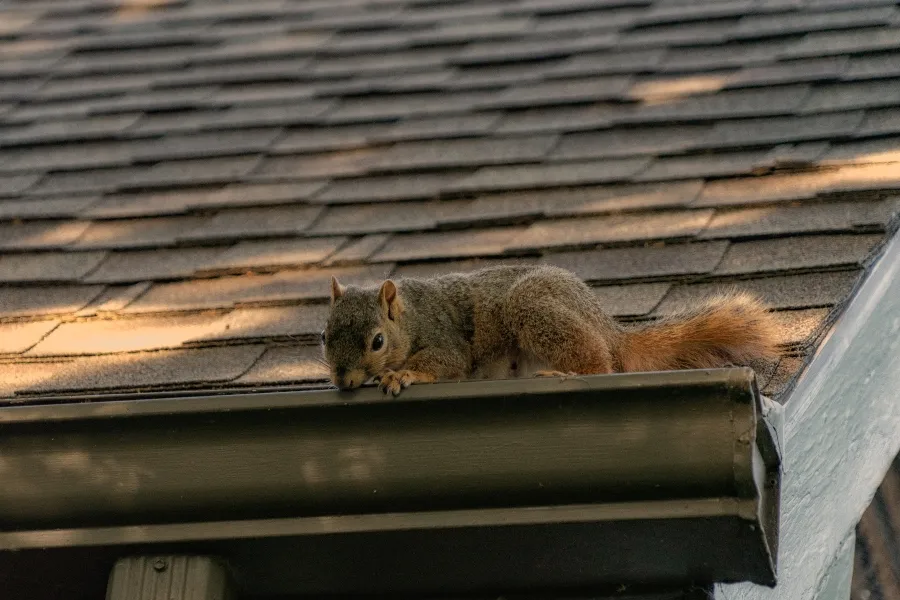
Squirrels targeting your roofline? Eastern gray squirrels, fox squirrels, and nocturnal southern flying squirrels across Virginia, Georgia, Louisiana, Florida, Maryland, and Illinois often gnaw on aluminum and vinyl downspouts, soffit panels, and fascia to shorten their continuously growing teeth, scavenge debris for nesting material, or widen gaps to enter warm attics.
Left unchecked, this rodent damage destroys your roof edge, exposes timber to soffit rot, and leads to costly structural and roof edge repairs.
Key Takeaways:
- Squirrel proofing requires addressing why rodents chew—primarily continuous incisor growth, territorial scent marking, and seeking attic access to nest near warm roofline gaps.
- Vinyl gutters suffer direct chew-throughs on end-caps and lips, while aluminum downspouts and seamless channels usually sustain joint, drip edge, and fascia junction damage.
- Stopping roofline damage relies on strategic tree trimming (6–10 ft clearance), heavy-duty steel gutter guards, and ½” galvanized hardware cloth over exposed soffit vents.
- Active interior infestations, high-altitude repairs, or maternal nesting require certified wildlife pest control specialists to execute humane exclusion and permanent roof restoration in compliance with local state wildlife regulations.
Jump to a Section:
- Primary Reasons Squirrels Target Your Gutters and Roofline
- Identifying Gutter Damage: Squirrels vs. Other Wildlife
- How to Prevent and Stop Squirrels from Chewing Your Gutters
- State Legal Regulations and When to Call Xceptional Wildlife Removal
Primary Reasons Squirrels Target Your Gutters and Roofline
Squirrels don’t chew on gutters for no good reason. They have a biological imperative to do so. Understanding what drives them to this destructive behavior is the first step to stopping it. Squirrel damage (and other types of rodent damage) along the roofline usually boils down to four main factors:
- Tooth Regulation: Like all rodents, a squirrel’s front teeth grow continuously throughout its life—about 4–5” per year. If they do not constantly file their teeth down by gnawing on hard surfaces like metal, vinyl, or wood, their teeth can become overgrown, preventing them from eating.
- Creating or Expanding Attic Entry Points: Gutters sit directly against the soffit, fascia, and roof edge—the most vulnerable areas of your home’s exterior. If a squirrel detects warm air escaping from your attic through a gap near the roofline, it will chew through the gutter, drip edge, or fascia board to widen the hole and build a nest inside.
- Clogged Gutters as an Attractor: Overflowing gutters packed with trapped leaves, pine needles, and oak debris act as an all-in-one resource hub. Squirrels target these clogged channels to scavenge dry organic material for attic nests and rely on the stagnant, trapped pool as a convenient, elevated drinking water source.
- Scent Marking and Territory: Squirrels have scent glands in their cheeks. Gnawing on prominent fixtures around their territory leaves behind both visual and chemical markers to warn competing squirrels away.
Identifying Gutter Damage: Squirrels vs. Other Wildlife
Not all roofline damage is caused by squirrels. Raccoons, rats, wood rot, and severe regional weather can also cause structural issues along your roofline. Identifying the specific signs of squirrel activity versus other wildlife or structural wear helps ensure you take the correct corrective steps.
| Feature | Squirrel Damage | Rat Damage | Raccoon Damage | Weather or Rot Wear |
|---|---|---|---|---|
| Bite Marks | Small, parallel pair lines (~1–2mm wide); sharp, uniform grooves on edges. | Paired grooves (~1–1.5mm wide); concentrated on corners, downspout openings, and seams. | Larger, jagged tear marks; frequent claw and pry marks. | No tooth marks; crumbling, soft, or flaking material. |
| Gutter Condition | Chipped edges, chewed vinyl lips, punctured aluminum corners. | Chewed plastic end-caps, gnawed rubber seals, chewed vinyl lips, grease marks along channels. | Bent, crushed, or completely pulled-down gutter sections. | Sagging sections, rusted metal, loose fascia nails. |
| Timing of Activity | Early morning and late afternoon (Diurnal – Gray/Fox Squirrels) or Night (Nocturnal – Flying Squirrels). | Middle of the night (Nocturnal). | Middle of the night (Nocturnal). | N/A |
| Noise Profile | Fast scurrying, light scratching, sharp chewing sounds near the roofline during daylight or nighttime. | Scurrying, high-pitched squeaks, scraping along downspouts and attics at night. | Heavy thumping, loud dragging, vocal chittering/growls. | Creaking during wind or temperature shifts. |
Vinyl vs Aluminum Gutters - Does It Matter?
Squirrels will chew through both types, but softer vinyl gutters are more vulnerable than aluminum. Depending on what you have, the type of damage you notice might be different – and come with different protection recommendations.
Need a Wildlife Removal Estimate?
| Gutter Material | Primary Vulnerability | Damage Characteristics | Primary Defense Strategy |
|---|---|---|---|
| Vinyl Gutters | High Chew-Through Risk | Made of relatively soft PVC that yields easily to incisors. Rodents chew directly through outer lips, corners, and end-caps to create entry holes or drinking access. | Install rigid, stainless steel micro-mesh guards that completely cap the open trough, eliminating access to soft synthetic edges. |
| Aluminum Gutters | Junction and Fascia Vulnerability | Flat, heavy-gauge runs are rarely chewed through, but squirrels aggressively target thin end-caps, seamed joints, and the roofline gap. | Pair gutter guards with a heavy-duty metal drip edge under the shingles to lock down the gap between the aluminum trough and wood fascia. |
How to Prevent and Stop Squirrels from Chewing Your Gutters
Stopping squirrels requires a combination of landscape adjustments, physical barriers, and targeted deterrents.
- Keep Gutters Clean and Free-Flowing: Clear out fallen leaves, standing water, and organic debris every spring and fall. Removing clogged material eliminates the primary source of nesting fodder and elevated drinking water that lures squirrels to your roofline.
- Trim Surrounding Tree Branches: Maintain a strict 6-to-10-foot clearance between tree limbs and your roofline. Squirrels can easily jump 6 feet horizontally and up to 9 feet from elevated branches onto your roof.
- Install Heavy-Duty Metal Gutter Guards: Covering your gutter channels with high-gauge, stainless steel micro-mesh guards prevents squirrels from accessing the inner lip of the gutter, resting inside the trough, or drinking trapped water.
- Add Metal Drip Edges and Hardware Cloth: Ensure your roofline has a sturdy, metal drip edge installed beneath the shingles extending into the gutter to protect exposed wood. For irregular gaps around fascia corners, soffit vents, or gutter junctions, seal the openings with ½” hot-dipped galvanized hardware cloth (wire mesh), which provides a rigid, chew-proof physical barrier that squirrels cannot penetrate.
- Remove Nearby Attractants: Relocate bird feeders, squirrel feeding stations, and pet food bowls far away from the perimeter of your home to reduce general wildlife traffic near your foundation and roof.
- Apply Taste Deterrents (Temporary Solution): Capsaicin-based sprays can temporarily discourage gnawing, but standard water-based formulas quickly run off smooth metal and vinyl. Opt for an oil-based capsaicin product or a formula with specialized binding agents to ensure it adheres to non-porous surfaces. Keep in mind that heavy rain will still require frequent reapplication.
- Contact a Professional Exclusion Specialist: A wildlife exclusion expert at Xceptional Wildlife Removal will perform a full assessment of your property in Virginia and identify structural modifications you can make to protect your home and its gutters from squirrels.
When to Call a Professional Wildlife Control Specialist
While trimming trees and adding gutter guards are effective preventative measures, active infestations require professional intervention. State wildlife protection laws govern how squirrels must be handled, excluded, or relocated across our service territory.
State Wildlife Regulatory Landscape for Homeowners:
| State | Species Regulation & Status | Permitting & Exclusion Rules |
|---|---|---|
| Illinois | Protected Furbearer / Game Species | Requires an Animal Removal Permit from the Illinois DNR before trapping or removing squirrels. |
| Maryland | Protected Game Species | Requires a Landowner Wildlife Damage Control Permit for nuisance trapping/removal. |
| Florida | Protected Game / Non-Game | No permit required for nuisance trapping on private property, but trapped wildlife cannot be relocated off-site; must be released on-property or humanely euthanized per FWC rules. |
| Georgia | Protected Game Species | Nuisance trapping allowed on private property; strict prohibitions against relocating wildlife onto public lands. |
| Virginia | Game Species / Nuisance Rules | Landowners may exclude or take nuisance squirrels causing property damage; relocation off-site requires strict adherence to Department of Wildlife Resources rules. |
| Louisiana | Small Game Species | Property owners may take or exclude nuisance wildlife causing structural damage in accordance with Louisiana Wildlife and Fisheries guidelines. |
Give Xceptional Wildlife Removal a call or send an email if:
- You Hear Scratching Inside Walls or Attics: This indicates that squirrels have already chewed entirely through the gutter line or soffit and established a nest inside your home.
- You Notice Severe Secondary Water Damage: Chewed, punctured, or misaligned gutters allow rainwater to breach your roofline. If left unaddressed, leaking runoff can back up into fascia boards, rot hidden roof decking, wash out flowerbeds, and pool directly around your foundation, risking basement leaks and structural settling.
- Babies Are Present: Attempting to seal entry points or block gutters during spring or late summer birthing seasons can trap juvenile squirrels inside, causing them to perish and create severe odor and hygiene issues.
- High-Altitude Work is Required: Working along roof edges and multi-story gutter lines carries significant safety risks without commercial-grade equipment and harness systems.
A professional wildlife control specialist from Xceptional Wildlife Removal in Virginia will conduct a full roofline inspection, navigate state-specific permit requirements, install specialized one-way exclusion doors to allow squirrels to exit safely without re-entry, humanely relocate trapped animals according to local regulations, and permanently seal all entry points using heavy-duty, chew-proof materials.


