
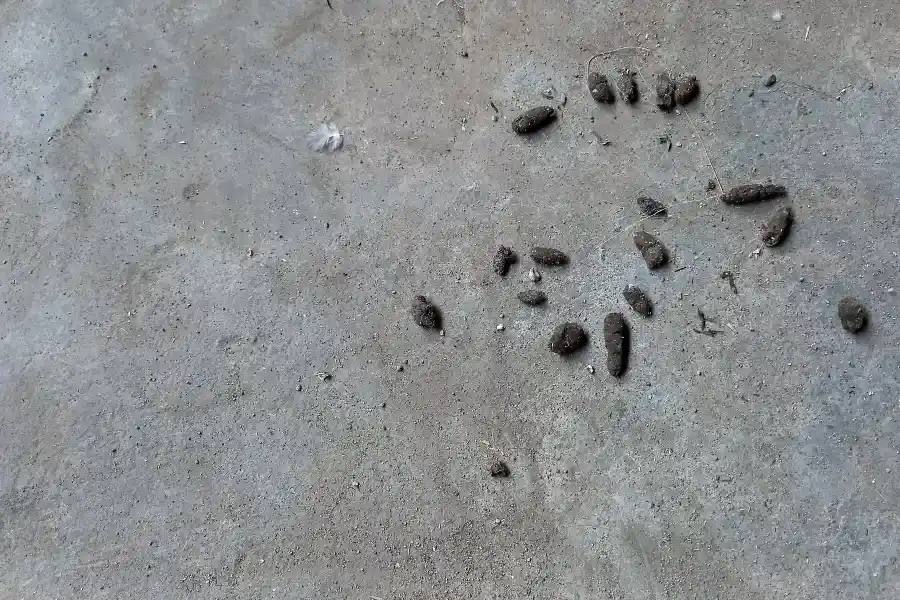
To accurately identify animal droppings without seeing the animal, evaluate four primary physical traits:
- Size: Length and thickness give an instant indication of the animal’s physical scale.
- Shape and Texture: Look for pointed vs. blunt ends, segmented tubular shapes, uniform pellets, or grooved cylinders.
- Contents: Visible seeds, insect casings, fur, crayfish parts, or white liquid caps reveal diet and species type.
- Location: High elevations (attics/rafters) point to climbers and fliers; floor level (along baseboards/cabinets) points to ground rodents; subterranean burrows and lawn diggings point to armadillos or skunks.
Key Takeaways:
- Evaluating an unknown dropping’s size, shape, diet contents, and localized placement provides vital clues to identify the specific pest without ever sighting the animal.
- Proper safety precautions—including protective gear, wet disinfection, and avoiding dry sweeping—are critical to prevent breathing in dangerous airborne spores (such as Hantavirus, Histoplasmosis, or Raccoon Roundworm) during cleanup.
- Recognizing specific waste patterns, such as bat guano with insect fragments or raccoons using distinct latrines, helps differentiate lookalike pest signs.
- Regional wildlife laws in Virginia, Georgia, Florida, Louisiana, Maryland, and Illinois strictly regulate bat exclusion windows during maternity season and govern the transport/relocation of rabies-vector species.
- Persistent infestations, contaminated air ducts, and concentrated waste piles require professional wildlife removal and biohazard restoration rather than standard home cleanup.
Unidentified animal droppings in your home or on your property are clear signals of an active pest or wildlife intrusion. Whether found in an attic, basement, crawl space, or garden, scat provides critical clues about the species present, the severity of the infestation, and potential property damage.
Immediate Safety Warning: Never sweep, vacuum, touch, or inhale dust near unknown droppings without proper protective equipment. Dry scat from species like raccoons, bats, and mice can release dangerous airborne spores and pathogens.
Jump to a Section:
- Wildlife Poop Identification Guide
- Regional Wildlife Laws & Relocation Regulations
- Found Droppings? Look for Secondary Environmental Clues
- Safe Wildlife Scat Cleaning and PPE Protocol
- FAQs About Wildlife Droppings
- When to Call a Professional for Wildlife Remediation
Wildlife Poop Identification Guide
Use this guide to quickly cross-reference physical traits with the most likely culprits found across our service territories in VA, GA, FL, LA, MD, and IL.
| Species | Average Size | Shape and Visual Features | Key Visual Indicators | Common Locations |
|---|---|---|---|---|
| House Mouse | 1/8″ – 1/4″ | Small, granular, pointed at both ends | Dark brown/black, similar to rice grains (Note: easily confused with palmetto bug waste in FL/GA/LA) | Kitchen pantries, along baseboards, inside drawers |
| Rats (Roof & Norway) | 1/2″ – 3/4″ | Capsule or spindle shape; blunt or pointed ends | Dark, shiny when fresh; hard and dull when old | Basements, crawl spaces, attics, wall voids |
| Squirrel (Gray & Flying) | 3/8″ – 1/2″ | Oval or oblong, smooth surfaces | Light brown, red, or dark; hardens with age | Attics, rooflines, garages, near bird feeders |
| Bat (Guano) | 1/4″ – 1/2″ | Small, dark, elongated pellets | Crumbles easily into shiny, metallic insect fragments | Directly below attic rafters, exterior walls, window sills |
| Raccoon | 2″ – 3″ long, 1/2″ thick | Tubular, blunt ends, highly variable | Contains undigested berries, seeds, or fur | Centralized “latrines” in attics, roofs, decks, tree forks |
| Opossum | 1″ – 2″ | Tapered ends, often curled or twisted | Moldy appearance quickly; uniform consistency | Crawl spaces, sheds, under decks, near trash cans |
| Skunk | 1″ – 2″ | Smooth cylinders, rounded ends | Heavy insect content (beetle shells, grasshopper legs) | Lawns, porch steps, crawl space entries |
| Armadillo (FL, GA, LA, southern IL) | 1/2″ – 1″ | Round or oval pellets, dense structure | Made almost entirely of dirt and digested insect parts | Lawn burrows, flower beds, under porch foundations |
| Nutria (LA, MD Eastern Shore) | 1.5″ – 2″ | Distinctly grooved, cylindrical pellets | Dark green to brown, noticeable longitudinal ridges | Near waterfront docks, crawl spaces, drainage ditches |
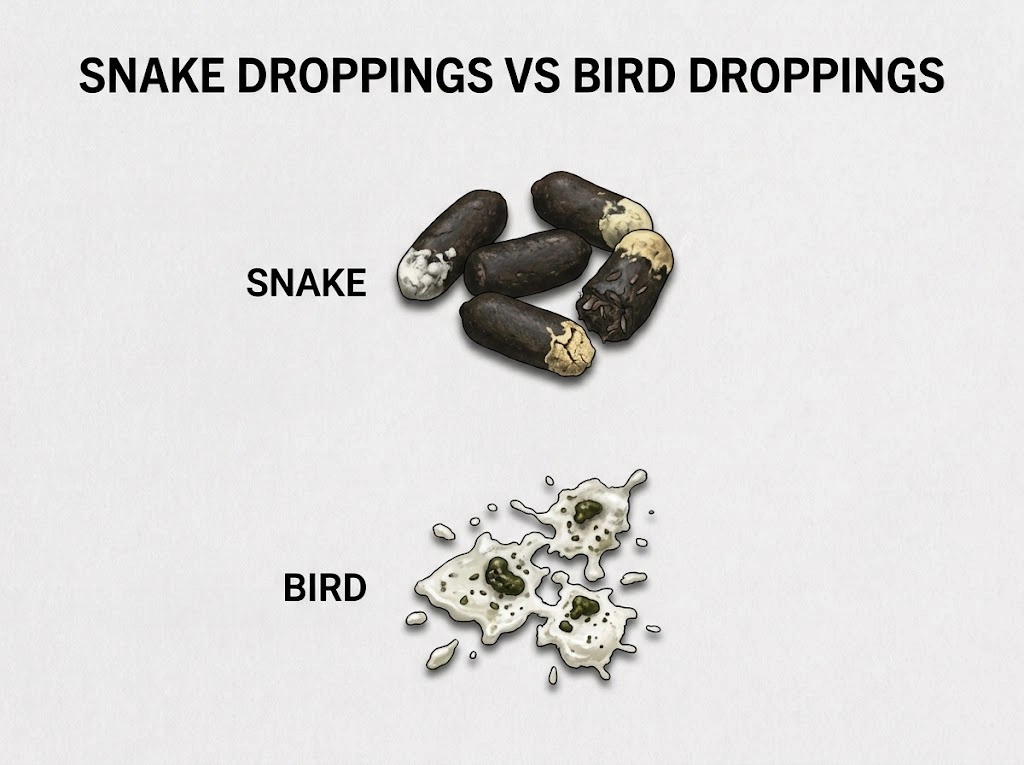
| Snake | Variable (1″ – 3″) | Elongated liquid/solid mix | Distinct white/pale cap (uric acid) attached to dark scat | Sheds, foundations, basements, sunny rock piles |
| Birds / Pigeons | 1/4″ – 1/2″ | Small, liquid blobs or twisted rolls | White paste mixed with dark/greenish matter | Ledges, rafters, roofs, cars, window sills |
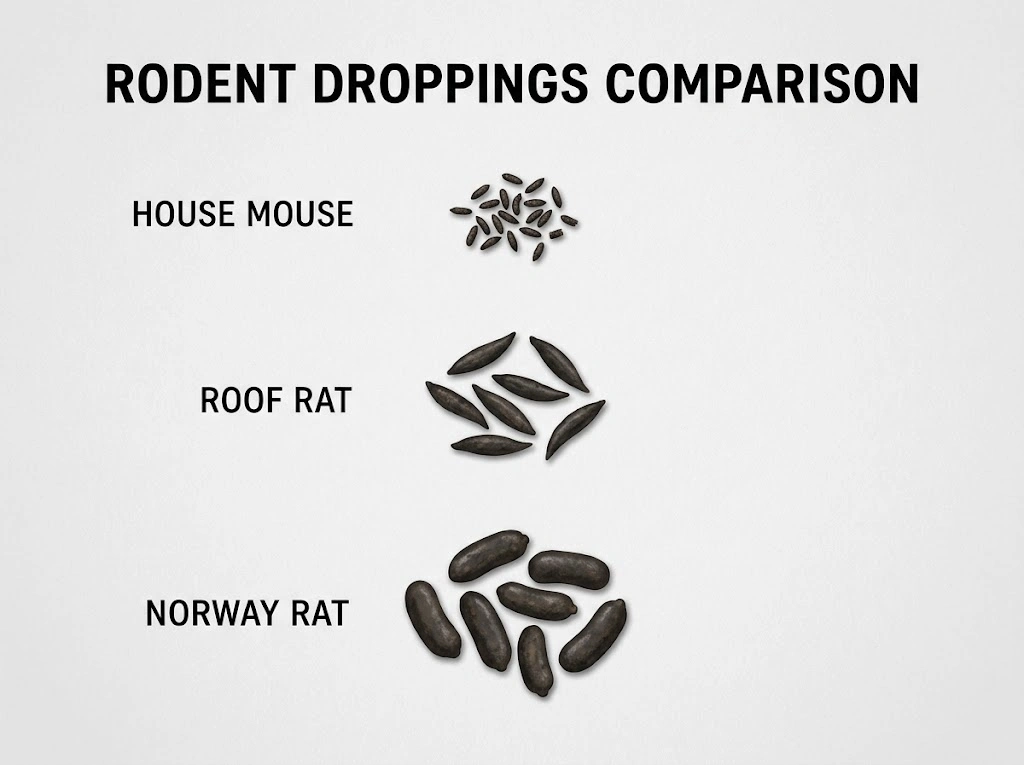
Rodents: How to Tell the Difference Between Mouse Droppings and Rat Poop
The easiest way to tell them apart is size: mouse droppings are tiny like rice grains (1/8 to 1/4 inch) with pointed ends, whereas rat droppings are significantly larger (1/2 to 3/4 inch) with blunt or spindle shapes.
You can also look at the pattern, as mice leave continuous, scattered trails along walls and cabinets, while rats cluster their droppings in specific areas near food or nesting sites. (In warmer southern regions like Florida, Georgia, and Louisiana, ensure you don’t confuse mouse droppings with cockroach/palmetto bug droppings, which are similar in size but feature distinct blunt, ridge-like sides).
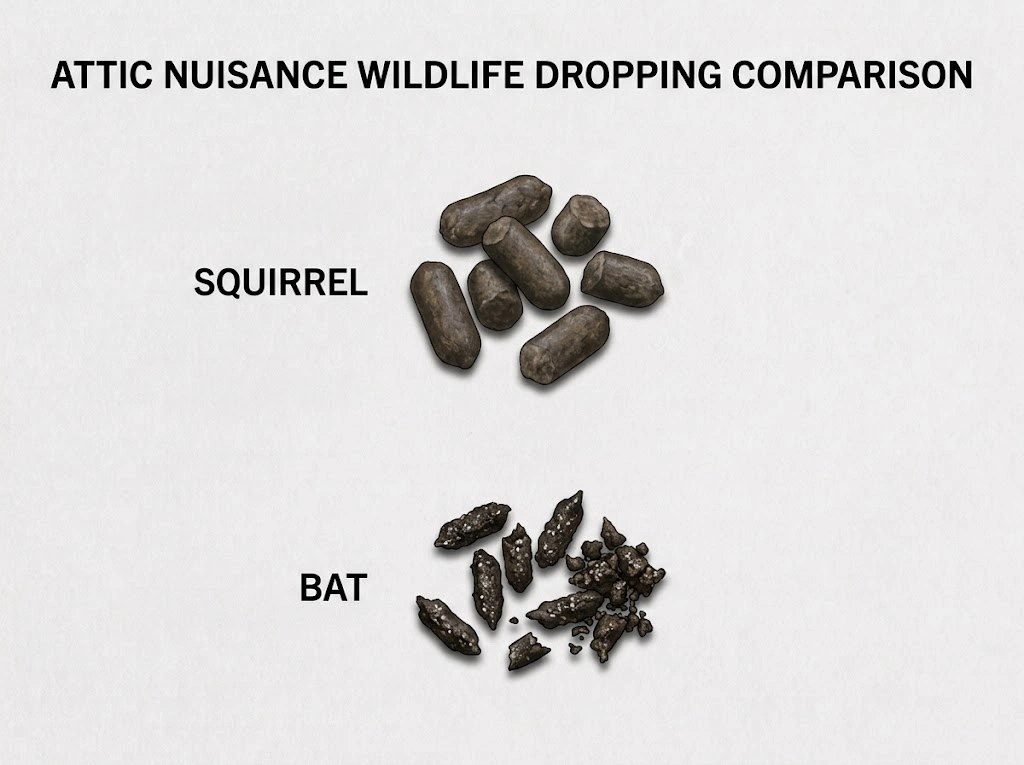
Bat vs. Squirrel Poop (Attic-Level Nuisance Wildlife Droppings)
Attic droppings are frequently misidentified. Homeowners often confuse bat guano with mouse or squirrel scat, but their structural properties are completely different. Bat guano forms distinct, concentrated piles directly underneath elevated roosting spots like vents and rafters, whereas squirrel scat is scattered along surfaces like floorboards.
Visually, bat guano is dark and often speckled with shiny, reflective insect wing fragments, while squirrel droppings are smooth, solid, oval-shaped capsules ranging from light brown to tan.
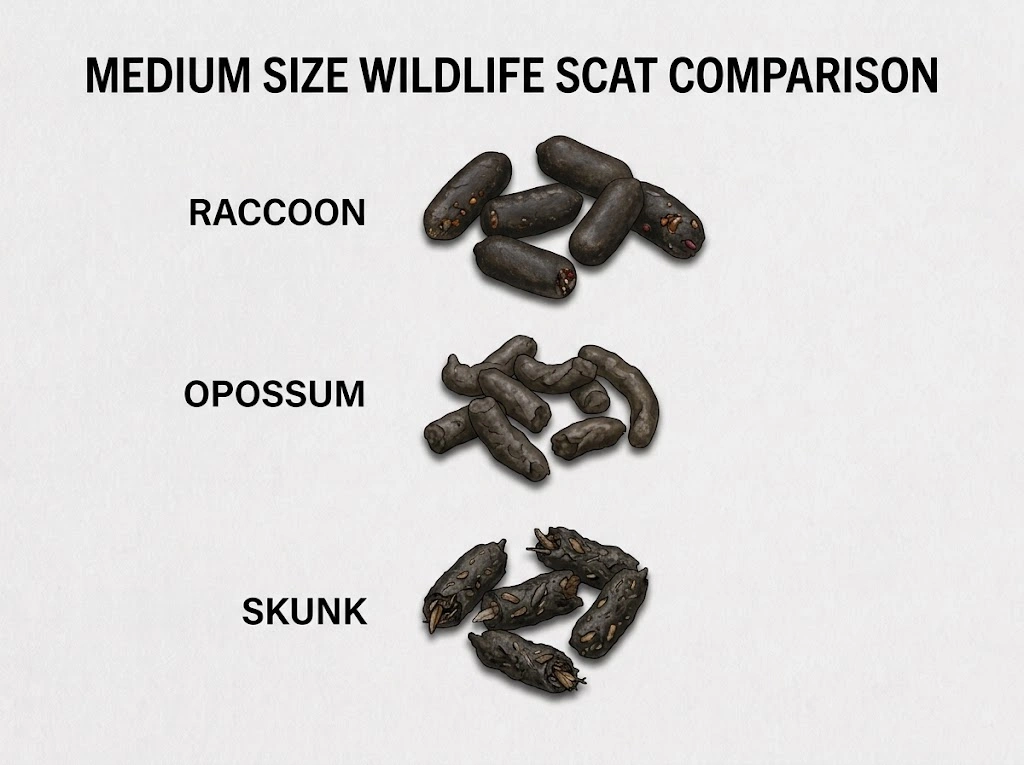
How to Tell the Difference Between Raccoon, Opossum, and Skunk Scat (Medium-Size Wildlife)
Larger droppings found in attics, yards, or sub-floor areas indicate medium-sized mammals that pose heightened physical and sanitation risks. Be especially careful if you believe you might have raccoon droppings, as these can contain raccoon roundworm eggs (Baylisascaris procyonis), which are highly dangerous.
- Raccoon Scat: Tubular and 2 to 3 inches long (resembles small dog poop), packed with undigested seeds, fruit, or bones, and always deposited in centralized “latrine” piles.
- Skunk Scat: Smooth, 1 to 2 inch cylinders packed with shiny insect parts, typically found outdoors near dug-up lawns or shed entrances.
- Opossum Scat: Tapered, twisted 1 to 2 inch segments with a smooth, uniform consistency. Due to its high moisture content, opossum scat deteriorates rapidly and frequently develops a distinct yellowish-white surface mold when deposited in humid crawl spaces, sheds, or under decks.
Snake and Bird Droppings (Non-Mammalian Pests)
Non-mammals process waste differently, combining liquid urine and solid feces into a single deposit.
- Snake Scat: Smooth, dark elongated mass attached to a hard white or light-yellow chalky tip (uric acid). Size varies significantly by species and age—ranging from 1 inch in juvenile or smaller species to over 3 inches in large adult snakes—and frequently contains undigested fur, bones, or claws.
- Bird and Pigeon Scat: Liquid-heavy white splatters with a dark green or black center that dry into a corrosive, chalky crust on flat surfaces or beneath roosts.
Regional Wildlife Laws & Relocation Regulations
When dealing with nuisance animals in Virginia, Georgia, Louisiana, Florida, Maryland, and Illinois, homeowners and pest operators must strictly comply with state wildlife codes. Handling rabies-vector species (RVS)—such as raccoons, skunks, and foxes—and state or federally protected species (bats) is regulated to protect public health and local ecosystems.
Need a Wildlife Removal Estimate?
| State | Bat Exclusion Maternity Blackout Dates | Rabies-Vector Relocation Laws (Raccoons/Skunks) |
|---|---|---|
| Virginia | May 1 – August 15 (Strict protection) | Illegal off-site. Must release on continuous property or humanely euthanize. |
| Georgia | April 1 – July 31 (DNR mandate) | Permitted within 72 hrs into suitable habitat with landowner approval. |
| Florida | April 15 – August 15 (FWC Rule) | Permitted only in same county on 40+ contiguous acres with written approval. |
| Louisiana | May 1 – August 15 (LDWF guidelines) | Relocation strictly restricted without state wildlife agency authorization. |
| Maryland | May 1 – August 15 (MD DNR regulation) | Illegal off-site. Must release on-property or humanely euthanize. |
| Illinois | April 15 – August 1 (IDNR regulation) | Illegal off-site. Relocation requires explicit IDNR permit; otherwise euthanize or release on-site. |
Note on Bat Protection: In all target states, it is illegal to kill, poison, or trap bats. Professional exclusion (using one-way valves) is the only legal removal method and cannot be performed during active maternity seasons when flightless pups are present in attics. Xceptional Wildlife Removal handles all bat exclusions in strict compliance with state and federal laws.
Found Droppings? Look for Secondary Environmental Clues
Droppings rarely exist in isolation. Use surrounding signs in your home to confirm species identity:
- Attics and Rooflines: Look for packed insulation paths (squirrels/raccoons), dark grease marks near entry holes (roof rats), or high-pitch squeaking/fluttering sounds (bats).
- Basements and Crawl Spaces: Look for shredded paper or fiberglass insulation nests (mice/rats), burrowed dirt tracks, or strong ammonia smells (rodent urine).
- Yards and Foundations: Look for 3- to 4-inch cone-shaped holes in turf (skunk or armadillo foraging), damaged garden fruit (opossums/raccoons), or shed skin fragments (snakes).
- Smell Indicators: Bat guano produces a heavy, sweet-musty odor; heavy rat or mouse infestations yield a sharp, unmistakable ammonia smell; skunks leave a sulfurous musk near entry points.
Safe Wildlife Scat Cleaning and PPE Protocol
When addressing minor animal dropping contamination, strict safety steps must be taken to prevent transmission of serious health hazards—including Hantavirus Pulmonary Syndrome (HPS), Histoplasmosis (common in fungal-rich soil/guano in the Midwest and Mid-Atlantic), Raccoon Roundworm (Baylisascaris procyonis), Leptospirosis, and Salmonellosis.
- Gear Up (PPE): Wear a properly fitted N95 or P100 respirator mask, heavy rubber gloves, and protective eye goggles.
- Do Not Sweep or Vacuum: Sweeping or dry vacuuming kicks infectious particles and fungal spores into the air.
- Saturate the Area: Spray the droppings thoroughly with an EPA-registered disinfectant or a diluted bleach solution (1 part bleach to 9 parts water). Let it sit for 10 minutes.
- Wipe and Bag: Pick up the soaked droppings using paper towels or disposable rags. Place all waste inside a heavy-duty plastic trash bag, seal it tightly, and double-bag it.
- Sanitize Surfaces and Hands: Thoroughly mop or wipe down surrounding surfaces with disinfectant. Dispose of gloves and wash hands thoroughly with warm water and soap.
FAQs About Wildlife Droppings
How can a homeowner tell if an animal dropping is fresh or old?
Fresh droppings are typically dark, moist, soft, and have a slight shine or sheen to them; they often emit a stronger, distinct odor. Old droppings dry out, turn dull or greyish, become brittle or chalky, and crumble easily when disturbed.
Assessing freshness helps you determine if you are dealing with an active, ongoing infestation or remnants from a past pest issue. NOTE: Do not touch or press on droppings to determine their age unless you are fully protected with skin and respiratory PPE.
How long do dangerous pathogens like Hantavirus or raccoon roundworm eggs remain active in dry scat?
Pathogens vary significantly in their survival rates:
- Hantavirus: Generally remains active in urine and droppings for about 2 to 3 days at room temperature, though cold or shaded environments can extend its viability slightly.
- Raccoon Roundworm (Baylisascaris procyonis) Eggs: Extremely resilient. The eggs can remain infective in soil or dry scat for months to several years, withstand freezing temperatures, and resist standard chemical disinfectants.
What specific commercial disinfectant products or EPA-registered chemicals are most
effective against wildlife biohazards?
Look for EPA-registered disinfectants labeled as bactericidal, virucidal, and fungicidal.
- Household Bleach: A freshly mixed solution of 1 part bleach to 9 parts water (0.5% sodium hypochlorite) with at least 10 minutes of contact time is highly effective against most bacteria and viruses (like Hantavirus).
- Phenolic or Quaternary Ammonium Disinfectants: Commercial products like Lysol IC, Sporicidin, or Microban Disinfectant Spray Plus work well on hard surfaces.
- Note on Raccoon Roundworm: Chemical disinfectants do not easily kill roundworm eggs; high-heat treatment (such as boiling water or high-heat steam cleaning above 140°F) is required to neutralize them.
What specific steps should be taken if someone accidentally inhales dust from droppings or touches scat without gloves?
Immediate Decontamination: If you touch scat, wash your hands immediately with warm water and antibacterial soap for at least 20 seconds. Scrub under fingernails thoroughly.
- Immediate Decontamination: If you touch scat, wash your hands immediately with warm water and antibacterial soap for at least 20 seconds. Scrub under fingernails thoroughly.
- Flush Exposure Sites: If dust gets in your eyes or mouth, flush generously with clean water or saline solution.
- Monitor for Symptoms: Keep a close eye on your health for the next 1 to 3 weeks. Watch for flu-like symptoms, fever, muscle aches, shortness of breath, headache, or gastrointestinal distress.
- Seek Medical Attention: If symptoms develop, visit a healthcare provider right away and explicitly inform them of your potential exposure to wild animal droppings in Virginia, Georgia, Louisiana, Florida, Maryland, and Illinois.
How can homeowners safely handle and clean soft, porous materials like carpets, furniture, or curtains contaminated by droppings?
Porous items cannot be disinfected with a simple wipe-down. Follow these steps:
- Remove Solid Waste: Put on protective gear (N95 mask, rubber gloves). Lightly mist the droppings with disinfectant to suppress dust, then carefully pick them up using paper towels. Never vacuum or sweep dry droppings.
- Machine-Washable Items (Curtains, Slipcovers): Wash in hot water using heavy-duty laundry detergent, then dry on high heat.
- Non-Washable Items (Carpets, Upholstered Furniture): Apply a commercial carpet/upholstery disinfectant or enzyme cleaner first. Then use a steam cleaner (hot water extraction) operating at a temperature of at least 160°F–170°F to sanitize deep fibers and neutralize pathogens.
- Severe Contamination: If urine or feces have saturated deep into carpet padding or furniture foam, the material should be cut out, safely bagged, and replaced.
Dealing with Wild Animal Waste in the Attic? Give Xceptional Wildlife Removal a Call
While minor mouse or bird droppings can often be cleaned safely using proper protocols, certain situations present severe health hazards and structural risks that require certified biohazard technicians and professional intervention:
- Accumulated Guano or Latrines: Large piles of bat guano or raccoon latrines emit toxic spores and require specialized HEPA containment, negative air scrubbing, and industrial biohazard disposal.
- Active and Recurring Infestations: If fresh droppings continue appearing daily in your home, cleaning waste without sealing entry points will not solve the root problem. Prevent pests from re-entering your home permanently with Xceptional Wildlife Removal’s long-term wildlife exclusion and structural proofing services.
- Contaminated HVAC Systems: Droppings inside air ducts disseminate airborne bacteria, mold, and parasite spores throughout your entire home whenever the heat or AC runs. Protect your indoor air quality with Xceptional Wildlife Removal’s professional HVAC and ductwork remediation.
- Attic Restoration and Insulation Damage: Wildlife nesting frequently destroys insulation and leaves soaked ceiling framing underneath. Xceptional Wildlife Removal strips ruined insulation, sanitizes structural timbers, and installs fresh insulation through our comprehensive attic remediation services.
Don’t let dangerous wildlife scat put your family’s health at risk. Whether you need a comprehensive property inspection in Virginia, Georgia, Louisiana, Florida, Maryland, and Illinois, professional decontamination, or legal wildlife removal, Xceptional Wildlife Removal’s certified specialists are ready to help.
Contact the Xceptional Wildlife Removal team today for a comprehensive property inspection and safe removal plan.


