
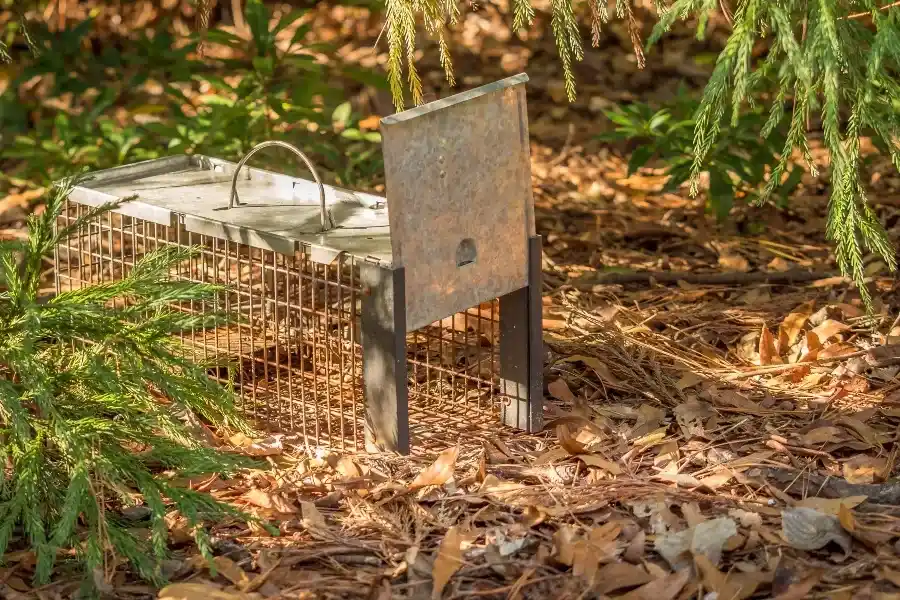
While DIY wildlife traps will occasionally successfully capture animals, they rarely solve an infestation because capturing an animal does not close the structural entry points allowing pests into your home.
DIY efforts almost always fail long-term due to incorrect trap sizing, improper baiting, scent contamination, and a lack of perimeter exclusion—leaving your property vulnerable to immediate reinfestation. Not only that, DIY trapping is often inhumane, causing excessive suffering to the trapped animal.
Key Takeaways:
- Root Causes Unaddressed: Trapping treats the symptom rather than the cause; without full structural exclusion, new animals quickly claim the vacated territory.
- High Failure Rates and Trap Shyness: Poorly sized traps or near-misses train animals to avoid traps entirely, making subsequent removal significantly harder.
- Severe Safety Hazards: Approaching or transporting wild animals exposes homeowners to aggressive bites, scratches, and dangerous pathogens like rabies, leptospirosis, and roundworm.
- Legal and Seasonal Liabilities: Relocating rabies-vector species off-property violates environmental regulations in Virginia (DWR), Georgia (GADNR), Louisiana (LDWF), Florida (FWC), Maryland (MD DNR), and Illinois (IDNR), while removing adult pests in spring risks leaving hidden litters to die inside walls.
Discovering a wild animal inside your home turns a routine day into an immediate crisis. Whether it is a raccoon shredding attic insulation, roof rats or squirrels chewing active electrical wiring, an armadillo or skunk burrowing beneath your deck, or nutria causing property damage, wildlife intrusions are active structural and biological hazards.
When faced with a wildlife problem, rushing to the hardware store for a metal cage feels like a proactive, budget-friendly move. However, it pays to understand why catching an animal is only a fraction of a true solution.
Jump to a Section:
- Why DIY Trapping Almost Always Fails
- DIY vs. Professional Wildlife Trapping – Which Is the Better Choice?
- Legal, Ethical, and Regulatory Realities of DIY Wildlife Trapping
- What Are the Best Types of DIY Traps?
- The Professional Wildlife Exclusion Process: How Xceptional Wildlife Removal Gets Long-Term Results
- DIY Wildlife Trapping FAQs
- Decision Time: DIY vs. When to Call Xceptional Wildlife Removal
Why DIY Trapping Almost Always Fails
Without specialized training, wildlife trapping often results in failure, frustration, and unexpected complications.
- Conditioned Trap Shyness: If an animal escapes a poorly set device, steals bait without triggering the plate, or experiences a near-miss, it becomes “trap shy.” Trap-shy animals learn to recognize and avoid cage devices entirely. Once an animal is conditioned to fear traps, removing it requires advanced, labor-intensive tactics—such as custom exclusion barriers or specialized snare systems—significantly increasing time and cost.
- Incorrect Trap Sizing and Selection: Traps that are too small cause physical trauma to animals trying to force their way inside. Traps that are too large often fail to trigger the pressure plate, allowing pests to steal bait freely while risking the capture of non-target neighborhood pets.
- Scent Contamination and Improper Placement: Wild animals possess an acute sense of smell. Human scent left on a cage—or fear pheromones remaining from a previously captured animal—deter target wildlife. Placing traps in open spaces rather than directly along established structural travel corridors drastically reduces success.
- Seasonal and Biological Dynamics: Wildlife behavior changes with the seasons across our service regions. During late fall and winter, animals seek warm structural shelter to survive cold weather. In spring and summer, females actively invade attics and wall voids to nest. Trapping a mother during nesting season leaves helpless offspring trapped inside walls, leading to animal suffering, severe odor issues, and secondary pest infestations.
- The Reinfestation Cycle: Catching an isolated animal treats the symptom, not the cause. Trapping a single pest without locating and sealing structural entry points leaves an open invitation for new wildlife to move into the vacated territory.
- Health and Safety Hazards: Approaching, transporting, or releasing wild animals exposes homeowners to bites, scratches, and dangerous pathogens like rabies, leptospirosis, and raccoon roundworm (Baylisascaris procyonis).
DIY vs. Professional Wildlife Trapping - Which Is the Better Choice?
Weighing a hardware store purchase against certified professional intervention from Xceptional Wildlife Removal comes down to choosing between a temporary patch and a permanent solution.
| Factor | DIY Wildlife Trapping | Xceptional Wildlife Removal Professional Services |
|---|---|---|
| Initial Success Rate | Low (trial-and-error; high risk of conditioning trap shyness) | High (species-specific removal protocols) |
| Long-Term Prevention | None (leaves structural entry points open) | Comprehensive (full perimeter exclusion and repair) |
| Safety and Health Risk | High (direct exposure to bites, scratches, and diseases) | Low (professionals use commercial PPE and sanitation systems) |
| Legal Compliance | High risk of accidental state regulatory violations (DWR, FWC, LDWF, MD DNR, IDNR, GADNR) | Full compliance with state environmental laws and municipal ordinances |
| Animal Welfare | High risk of animal trauma, stress, or orphaned litters | Humane handling, exclusion, and nesting checks |
| Cost and Financial Relief | Low initial cost, but high long-term cost (unaddressed damage; potential insurance claim issues) | High value (resolves root cause; often eligible for insurance coverage) |
Legal, Ethical, and Regulatory Realities of DIY Wildlife Trapping
Before setting a single trap, homeowners must confront a hard truth: urban wildlife management isn’t a free-for-all. Trapping a wild animal triggers a complex web of state environmental mandates, public health laws, municipal noise ordinances, and animal welfare ethics that most DIYers never anticipate.
- Strict Legal Frameworks: State agencies—such as the Virginia Department of Wildlife Resources (DWR), Georgia DNR, Louisiana Department of Wildlife and Fisheries (LDWF), Florida Fish and Wildlife Conservation Commission (FWC), Maryland Department of Natural Resources (MD DNR), and Illinois DNR—enforce strict regulations on wildlife handling. Relocating Rabies Vector Species (RVS)—such as raccoons, skunks, foxes, and bats—off-property is explicitly prohibited in most jurisdictions to prevent disease transmission. Homeowners are frequently restricted by state law to releasing captured animals on the immediate property or having them humanely euthanized by a licensed professional.
- Permit and Licensing Requirements: Many state agencies require specific permits or commercial Wildlife Control Operator (WCO/NWCO) licenses to trap, transport, or possess game animals, fur-bearers, and protected species. Trapping without proper state authorization can result in substantial state fines or citations.
- Municipal Noise and Nuisance Ordinances: Leaving a trapped animal unattended in a backyard cage can quickly trigger local animal control citations or municipal nuisance complaints due to distress vocalizations and nocturnal noise disruptions. Local ordinances frequently dictate maximum trapping inspection windows (often requiring mandatory checks every 12 to 24 hours), exposing negligent DIYers to animal cruelty penalties if traps are not continuously monitored.
- Animal Welfare and Inhumane Conditions: Unintentional cruelty is a primary byproduct of amateur trapping. Without professional monitoring schedules, animals trapped in cage devices frequently suffer from rapid severe dehydration, hyperthermia or exposure in direct sunlight, and self-inflicted physical trauma—such as broken teeth or facial lacerations—from desperately attempting to chew through steel mesh.
What Are the Best Types of DIY Traps?
Selecting the right device requires matching the target species’ biology and size to the correct trap design. Using the wrong trap type virtually guarantees failure, ranging from bait theft and trap destruction to severe animal trauma or accidental pet capture.
Need a Wildlife Removal Estimate?
| Trap Type | How It Works | Target Wildlife | Operational Limitations | License or Permit Required? |
|---|---|---|---|---|
| Single-Door Live Cage | A humane live cage trap where an animal steps on a plate to reach bait, triggering a spring or gravity door. | Raccoons, Skunks, Groundhogs, Opossums | Smart animals reach around the plate; improper sizing allows bait theft or pet capture. | No for purchase; Yes in VA, GA, LA, FL, MD, and IL to relocate/transport captured RVS off-site. |
| Double-Door Live Cage | Dual doors create an open tunnel along travel paths, closing via a central plate. | Squirrels, Chipmunks, Rats | Fails in open spaces; requires precise placement directly along structural travel lines. | No for placement; Yes to relocate protected or game species off-site. |
| One-Way Exclusion Door | Mounted over entry points; allows animals to exit but mechanically blocks re-entry. | Squirrels, Raccoons, Bats | No containment. Fails unless all secondary structural entry points are sealed first. | No permit needed for installation on private property (Note: Bat exclusion has state seasonal restrictions). |
| Body-Grip / Lethal Snap | Heavy-duty mechanical trap designed to crush or asphyxiate on contact. | Rats, Mice, Voles | Severe safety hazard to pets and humans; killing or relocating protected species violates state wildlife laws. | No for commensal rodents; Yes (trapping license/permit) for larger or non-rodent species. |
| Dog-Proof Foot-Hold | Enclosed cylinder requiring a pulling motion to lock onto a paw. | Raccoons, Opossums | Leaves animal restrained in place; requires manual handling, exposing users to bites and disease. | Yes in most states (requires a state trapping license or commercial permit). |
The Professional Wildlife Exclusion Process: How Xceptional Wildlife Removal Gets Long-Term Results
Eliminating an animal intrusion isn’t a single event—it’s a systematic process. Where a DIY approach starts and ends with setting a wire cage, Xceptional Wildlife Removal relies on a multi-stage protocol designed to clear the animal, repair the structure, and ensure it won’t return:
- Comprehensive Property Inspection: Identifying the specific species, assessing structural damage, finding primary and secondary entry points, and determining if young are present.
- Targeted Trapping and One-Way Exclusion: Utilizing commercial-grade, species-specific traps or installing one-way exclusion doors that allow animals to exit the structure safely without being able to re-enter.
- Perimeter Exclusion and Repairs: Sealing all entry points with chew-proof materials such as ¼” or ½” hot-dipped galvanized steel mesh, 19-gauge or thicker hardware cloth, metal flashing, and industrial sealants.
- Sanitation and Decontamination: Cleaning and disinfecting contaminated nesting sites to eliminate harmful pathogens, parasites, and lingering scent markers that attract other animals.
DIY Wildlife Trapping FAQs
Why can’t I find a fixed price online for professional wildlife trapping?
Wildlife removal isn’t a one-size-fits-all service like purchasing a piece of hardware. Every intrusion presents a unique set of variables: the animal species involved, the location and accessibility of the entry points (e.g., ground-level deck vs. a three-story roof peak), the severity of structural damage, whether a litter of offspring is present, and the total square footage requiring exclusion and biological decontamination.
Because a permanent solution depends on a full physical assessment, an accurate estimate from Xceptional Wildlife Removal requires a comprehensive on-site property inspection].
Isn’t DIY live trapping significantly cheaper than hiring a professional?
On paper, buying a retail trap appears less expensive. However, a complete DIY attempt requires purchasing specialized traps, species-specific bait, personal protective equipment (PPE), ladders, and heavy-gauge repair materials like galvanized steel mesh.
More importantly, DIY trapping carries substantial hidden costs:
- Compounding Structural Damage: While trial-and-error trapping drags on, animals continue shredding insulation, gnawing structural timber, and chewing live electrical wires, creating serious fire hazards.
- Secondary Infestations: Catching one animal without sealing structural entry points leaves an open doorway for new pests to move in immediately.
- Property Contamination and Insurance Coverage: Unaddressed nesting sites accumulate urine, feces, and ectoparasites, eventually requiring full attic restoration. Fortunately, many homeowners insurance policies help cover the cost of professional wildlife damage repair, attic insulation replacement, and biological decontamination—a financial safety net that DIY efforts cannot leverage.
- Medical and Legal Liabilities: Medical treatments for scratches/bites or state and municipal fines for illegal wildlife relocation create massive out-of-pocket expenses.
Decision Time: DIY vs. When to Call Xceptional Wildlife Removal
When You Might Try DIY Prevention
- Keeping raccoons and opossums out of trash cans by securing lids or using wildlife-proof containers.
- Installing visual or auditory deterrents in outdoor gardens for temporary relief from small ground pests.
- Trimming tree branches away from your roofline to limit animal access to the attic.
When You Should Call Xceptional Wildlife Removal Immediately
- Any animal activity inside the attic, crawlspace, chimney, or wall voids.
- Signs of chew damage on electrical wiring, structural wood, or HVAC ductwork.
- Encounters with high-risk rabies-vector species (raccoons, skunks, foxes, or bats) or invasive nuisance wildlife.
- Evidence of a mother animal with a litter on the property.
Attempting to trap wild animals on your own often leads to wasted time, damaged property, and unnecessary safety risks. If wildlife has entered your home or is causing persistent damage to your property, a professional assessment by the wildlife control experts at Xceptional Wildlife Removal is the safest and most effective way to restore peace of mind.
Contact Xceptional Wildlife Removal today to schedule a comprehensive property inspection, safe removal, and professional perimeter exclusion in Virginia.


