
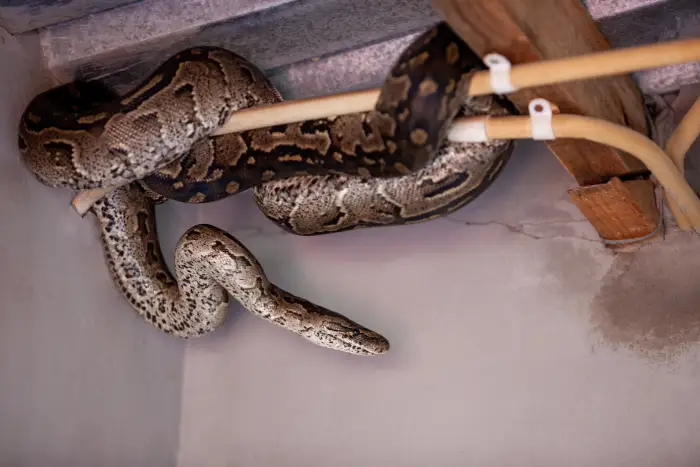
Think You Have a Snake in Your Wall?
Some noises are expected in a house, like the hum of a fridge or a settling floorboard. But when you hear something unusual coming from behind your drywall, it’s cause for concern. And if it sounds like a slow friction, that might signal you have snakes in your walls. It’s a worrying feeling, and your mind starts racing with questions.
Is it a venomous species? Could it slip through the baseboard gap into the bedroom while I’m sleeping? How many are actually in there?
At Xceptional Wildlife Removal, we specialize in alleviating those fears for homeowners. While discovering a snake in the wall feels like an emergency, we deal with these kinds of issues routinely. Here’s everything you need to know about having a snake in the wall.
Can Snakes Hide in Your Walls?
Yes, snakes can hide in your walls, and while it’s not exactly common, it happens more often than you would think. To a reptile, your home’s infrastructure is essentially a collection of climate-controlled caves.
It offers protection from predators and the elements, providing a perfect, quiet highway between the studs where they can rest undisturbed and regulate their body temperature.
How Do You Know If You Have a Snake in Your Walls?
When you hear movement in the dark, your mind often jumps to the worst-case scenario. However, identifying the inhabitant requires a bit of detective work. Unlike mammals, snakes in walls leave a very specific signature. Here is how you can tell the difference:
- A Sliding Sound: Instead of the pitter-patter of rodents, you’ll hear a continuous, low-frequency dragging sound as the snake moves across the drywall.
- Complete Silence: When you don’t hear the snake, it may seem like they’re gone, even when they’re still right there. Rodents are vocal and frantic. Snakes are ghostly silent, often staying perfectly still for hours or even days.
- Shed Skins: Finding a translucent, scaly “sock” near a utility gap or in your attic is a definitive warning sign that there’s a snake in your wall.
- Snake Droppings: Droppings are often dark and cord-like, usually capped with a white, chalky substance called urates.
- Regurgitated Prey: Occasionally, a stressed snake will expel a recent meal. Finding a dead, intact rodent in a strange place can be a sign of a predator nearby.
Need a Wildlife Removal Estimate?
How Does a Snake Get into Your Wall?
Snakes are masters of physical compression. If their head can fit through a gap, their entire body can follow. Often, these cracks lead directly into the wall voids.
A snake may enter seeking a temporary spot to hide and become trapped, or worse, it may find an interior gap—like those under cabinets or behind appliances—and slip into the rest of your home, creating a tense situation for everyone involved.
They typically exploit the smallest weaknesses in your home’s exterior:
- Foundation Cracks: Tiny fissures in concrete or brick at ground level.
- Utility Entry Points: Unsealed gaps around plumbing pipes, HVAC lines, or electrical conduits.
- Weep Holes: The small ventilation gaps in brick siding are common “front doors.”
- Roofline Access: Climbing species can move from tree limbs to your roof, entering through damaged soffits or fascia boards.
Why Is a Snake in Your Wall?
A snake doesn’t enter your home to bother you; it is following its basic biological drives. Usually, they are drawn inside for one of these reasons:
- Food: They follow the pheromone trails of mice or rats that have already established themselves in your walls.
- Comfortable Temperature: Your insulated walls offer a stable temperature that protects them from the heat or a sudden winter chill.
- Safety: Snakes love to hide. Walls provide a predator-free zone where they can safely digest a meal or undergo the vulnerable process of shedding their skin.
What Kinds of Snakes Are Most Likely to Be in Your Wall?
Depending on your specific region, the “usual suspects” vary. In our service areas across Virginia, Georgia, Louisiana, Florida, Maryland, and Illinois, we frequently encounter:
- Brown Snakes: Very small and common in Virginia backyards, these harmless snakes frequently slip into basements and lower wall voids.
- Water Snakes: If you live near a pond or lake, these may enter lower walls seeking moisture, often being mistaken for more dangerous species.
- Rattlesnakes: While they’re less common, rattlesnakes may seek shelter in crawlspaces or ground-level wall gaps in the South and Midwest.
- Garter Snakes: Often found in lower wall sections or basements near the foundation, especially in Maryland and Illinois.
- Rat Snakes: The undisputed kings of climbing. They are one of the most frequent species found in structural voids across the Mid-Atlantic and Midwest.
- Corn Snakes: Especially in the Southeast, these are slender and adept at finding small entry gaps.
Is a Snake in Your Walls Dangerous?
While finding a snake in wall cavities is frightening, the good news is that most are not dangerous to humans. However, the situation warrants immediate, professional action. In our Southern service regions, the possibility of a rattlesnake in your wall or a copperhead seeking shelter is a reality that cannot be ignored.
Even non-venomous snakes present hazards:
- Defensive Attack: A homeowner accidentally cornering a snake can result in a defensive strike.
- Electrical Risks: A snake coiled around wiring can occasionally bridge contacts, potentially causing a short circuit.
- Odor Issues: If a snake becomes trapped and dies in a wall, it creates a pungent, foul decay smell, often requiring dead animal removal service to solve.
What to Do If You Have a Snake in Your Walls
If you hear that tell-tale sliding sound, follow these steps to manage the situation safely:
- Stay Calm: Do not poke wires or sticks into the wall to “flush it out” — this only agitates the snake.
- Leave the Exit Open: Never seal a suspected entry hole until you are certain the snake is out, or you will trap it to die inside.
- Contain the Area: Tuck towels under the door of the room where you heard the noise to prevent the snake from entering your living space.
- Call a Professional Snake Control Expert: Because you cannot identify what you cannot see, treat the situation as if it could be dangerous until an expert arrives.
How to Get Rid of a Snake in Your Walls Safely
While the thought of a snake in your wall is alarming, it doesn’t have to be a disaster. At Xceptional Wildlife Removal, we deal with these slithering intruders every single day. We use specialized cameras and extraction tools to locate the intruder and remove it humanely.
You don’t have to live with the anxiety. We are the premier choice for snake control and removal near you, providing the technical skill to remove the threat and the construction knowledge to seal your home so they never return.
Got questions or ready to schedule? Call or email us today!
Back to Snake Removal – Control – Trapping


